Subhashis Das
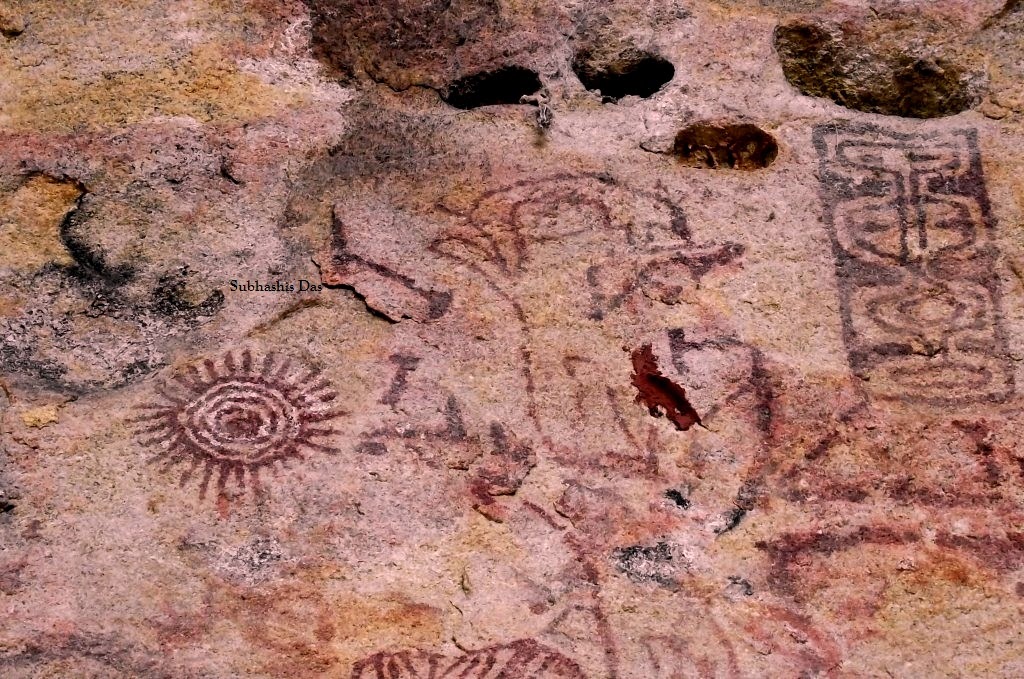
A collage of the various motifs of the prehistoric Isko rock art

The iconic rock art of Isko. Hazaribagh. Jharkhand. East India.
The Isko rock shelter that comprises the prehistoric art
Isko: a small tribal village about 30 kms off Hazaribagh. The village is renowned world over for the very primitive Rock Paintings in its vicinity.
The site was originally discovered by a Jesuit priest Fr.Tony Herbert way back in the early nineties and was subsequently researched and popularised by Bulu Imam.
The site unlike most of other rock art sites in India and around Hazaribagh which contain the common hunting scenes, Isko is very unusual as it stands out prominently for its paintings of the enigmatic abstract geometrical designs making it a very rare site and a treat to watch.
The Mother Goddess giving birth
 |
A DEER IS SEEN IN THE PANEL. One natural depression is used as a motif while the others are left untouched.
|
 |
A possible proto Brahmi script
|
However Isko does house animals as bison, buffalo, deer and amphibians as frogs and reptiles as turtles too. And there are the enigmatic X-ray motifs of a few animals as well found in several other rock art sites of India and that of Europe.
But the intricate geometrical designs are most mysterious. No one can explain the meanings of these icons. These are believed to have been drawn by the priests (pahans or shamans) under the spell of intoxication hence are scared and these are still worshipped by the local tribals. Latest research ofcourse now reveal that such very primitive rock arts were the work of the womenfolk which I truly believe.
 |
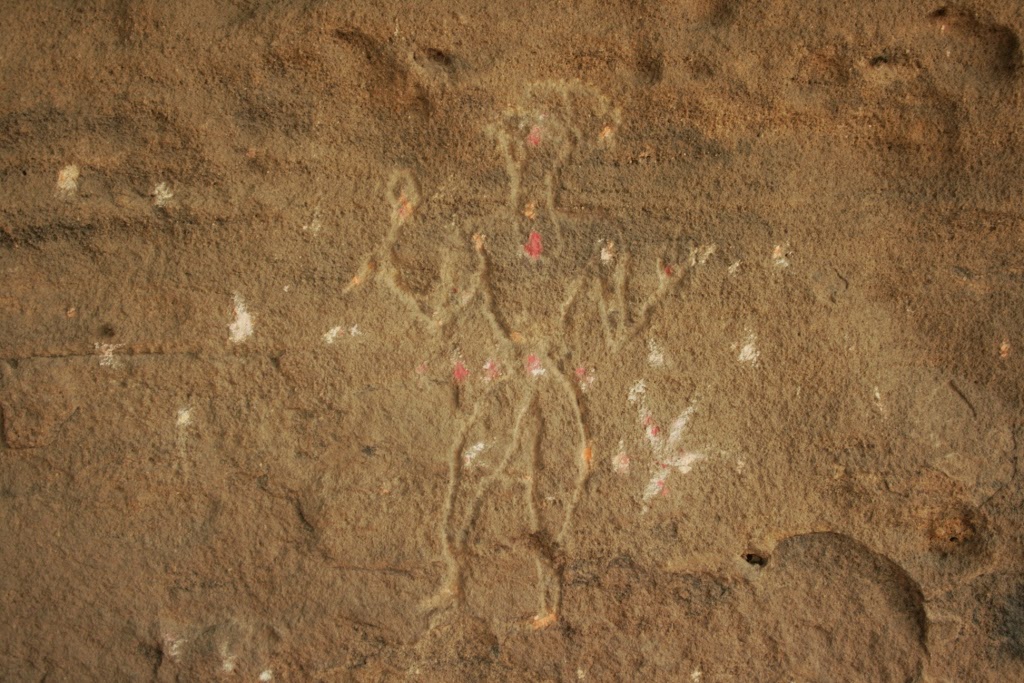
An alien like figure
wearing a space-suit like costume and donning even a
helmet like head gear.
|
 |
The team
comprising of the author at the centre, Krishna (far left), Sarthak Sinha
(Prantik's friend), Prasann Mishra to the right and Venantious Pinto from New
York farthest right. Pic clicked by Prantik Das (author's son). The panels are
at the back.
|
 |
Fascinating prehistoric intricate designs
|
Isko is believed by many to be meso-Chalcolithic, while some have assigned it to as far as the middle Paleolithic era around 25 to 20000 BCE. The drawings clearly show under layers of the more recent ones; meaning the bottom layers must be of more hoary antiquity and may predate even Bhimbetka.
Unimaginative work by the government of cementing the floor of this significant site through which a thin stream of water once flew has ruined the chance of finding microliths and any other very primitive relic from here.
 |
A deer is in the middle amidst a mayhem of icons
|
 |
A petrogyph of a man, worshipped by the local Mudari/Oraon tribals as their most revered deity of Sin Bonga.
|
THE MARWADUWAR CAVE
This fascinating Marwaduwar cave is about a km or two from the Isko rock
shelter. One reaches here by crossing rough terrains, jungles and shrubs.
There are two entrances to this cave. A subterranean flow of water which a
chattering sound burgeons the mystery that hangs in the air inside.
The Matwaduar is normally associated with
marriage ceremonies that were once held here. The legend goes that even the
local king and queen too held their marriage here. Marriage customs inside caves actually
signifies the very primitive pre-Brahmanical birthing rituals held inside caves. Caves were deemed as the womb of the Great Mother; all appendages of the now obsolete fertility cult.
Today inside the cave some holy man has placed a trishula and a few
spherical stones and have been smeared them with sacred sindoor. Very soon the cave will be filled with
devotees and annuals fairs be held. In the process the very primitive atmosphere here would be soon a thing of the past. Bad times ahead for this alluring cave and even for the Isko rock art next door.
 |
The large Marwaduwar cave of Isko
|
 |
Entering the cave
|
 |
Though blurred yet Prantik can be seen crawling towards the tunnel inside the cave.
|
 |
A memorial dolmen inside the cave. Below it flows the water stream.
|
The cave is connected with tunnels that run deep inside. That primitive people had been using these conduits and caves as sacred places is evident with the various graves that can be seen all around the inside.
 |
One of the few conduits inside the cave that lead deep inside.
|
 |
One of the few sacred vulvar shaped crevices, representative of the Mother Goddess.
|
 |
I try entering into one of the conduits.
|
 |
Opening of an another cave which too has deep tunnels that are interconnected with the Madwaduwar Cave.
|
 |
The two vulva shaped tunnels inside this other cave that leads to a possible hall and more interconnected conduits.
|




.jpg)